


Rubini Profumi is one of the most unique perfume brands to have emerged from the joyful burgeoning of Italian scent making in recent years. Founder and Creative Director Andrea Bissoli Rubini and his collaborators have created a body of perfumes with distinctive cores.
The detailed olfactive imagination that runs through all three perfumes is key to Rubini. Andrea Rubini describes them as imagined worlds, worlds that come alive in the osmosis of our skin and his perfumes, filling up our senses like an arena of scented history.
RUBINI PROFUMI
Filters


Rubini Profumi: Italian Perfume as an Imagined World
Rather than beginning with a familiar category — woody, floral, aromatic or amber — each Rubini perfume starts with a place, memory, cultural reference or improbable scene, then develops its own olfactory language around it.
Across Rubini perfumes, Italian identity appears through landscape, literature, wine, design, motorsport and lived memory rather than a single recognisable scent signature. The result is an Italian perfume brand with a particularly cinematic point of view: pastoral hillsides can sit beside racing fuel, roasted coffee beside sacred resins, or marine salt beside the rubber of a diving suit. As an independent perfume house, Rubini is imaginative without becoming arbitrary; every strange detail belongs to the world being built.
Two Generations of Scent: Memory Reimagined
Andrea Rubini's relationship with perfumery reaches back to his grandfather's fragrance business in post-war Italy. That family history became the emotional starting point for Fundamental, but Rubini treats heritage as material for reinvention rather than something to preserve unchanged. Vintage leather, iris, wax and woods meet the distinctive character of the Garganega grape used in Soave wine, giving personal memory a stranger, more tactile form.
This relationship between inheritance and transformation runs throughout the collection. Virgil's pastoral Italy becomes Odenaturae; the mythology of Italian racing becomes Nuvolari; other compositions move towards ritual, outer space or the sea. These perfumes feel artisanal not because they imitate the past, but because a specific idea is worked through carefully from concept to formula. Here, perfumery becomes an act of imaginative reconstruction.
Andrea Rubini and Cristiano Canali: A Decade of Creative Dialogue
A defining part of Rubini Profumi is the long creative dialogue between Andrea Bissoli Rubini and perfumer Cristiano Canali. Andrea establishes the narrative, atmosphere and emotional direction; Canali translates that world into material, structure and movement on skin. Their collaboration produces fragrances that can feel highly conceptual while remaining sensorially precise.
The consistency of this Italian niche perfume house does not come from repeating the same notes. Instead, it comes from a shared method: rich raw materials, strong contrasts, unusual accords and compositions that change noticeably as they settle. One niche perfume may move from grape and powder into leather; another from coffee into florals and resins; another from metallic heat into vetiver and oud. The perfumes are also best understood as unisex perfumes — chosen by atmosphere and personal response rather than conventional gender categories.
Wine, Fuel, Coffee and Cosmic Dust: The Art of the Signature Accord
Rubini's most distinctive device is the signature accord: a specially constructed olfactory idea that allows an abstract story to become smell. In Fundamental, the Soave grape accord captures not simply wine but its yeasty, fruity, almost tactile atmosphere, with the strange sweetness of noble rot adding another facet. Nuvolari goes somewhere entirely different, building speed through gasoline, asphalt, hot rubber and metallic impressions.
Tambour Sacré centres on roasted coffee absolute, surrounded by tuberose, spice, myrrh and balsamic resins until coffee becomes something ceremonial rather than merely gourmand. Hyperion expands outward with Supernova and Deep Space accords, imagining cold metal, dust, gas clouds and cosmic emptiness against incense and creamy woods.
The same approach continues underwater in L'Eau Très Mer, where salty skin, a diving suit accord and marine depths turn the pause after a dive into perfume. These effects are not novelties added for shock. They give each composition its internal logic — the detail that makes an imagined world suddenly believable.
From Pastoral Italy to Outer Space: How to Choose a Rubini Perfume
Begin with the atmosphere you want to inhabit. Fundamental is wine-soaked, powdery and leathery, with an almost vintage sensuality, while Odenaturae moves towards herbs, flowers and the sunlit disorder of an Italian pastoral landscape. Tambour Sacré brings coffee, spice, tuberose and resin into something darker and more ceremonial.
For greater provocation, Nuvolari explores fuel, metal, racing heat and asphalt, while Hyperion moves in the opposite direction: cold, abstract and cosmic, with incense, metallic effects and creamy woods creating the sensation of deep space. Idìlios offers a softer route through peach, osmanthus, green tea, coconut, vanilla and musk, while L’Eau Très Mer turns towards salt, tropical fruit, rum, tobacco and the strange intimacy of a diving suit against skin.
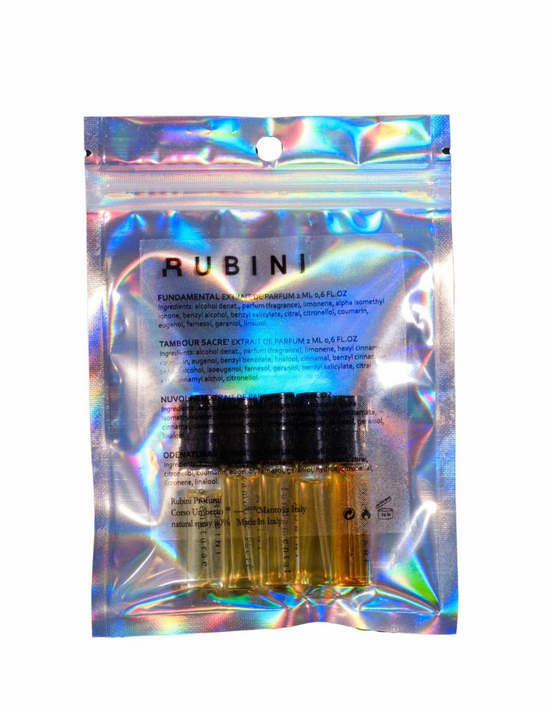
These perfumes are best chosen by mood rather than conventional fragrance family or gender. Their contrasts also develop noticeably over several hours, so sampling is particularly useful before committing to a full bottle. For a broader introduction to the house, the Rubini Discovery Set allows you to experience the different worlds of Rubini Profumi side by side.
The Sainte Cellier Edit: Four Rubini Perfumes to Explore
Fundamental is the natural starting point for understanding Rubini Profumi. Built around the distinctive character of Soave wine and the Garganega grape, it brings together powdery iris, vintage leather and the atmosphere of family memory. It captures the origins of the house particularly well: Italian heritage translated into something tactile, personal and unexpectedly modern.
Nuvolari turns Italian motorsport into scent. Italian lemon, Madagascan black pepper and a fuel accord open with heat and velocity; mint, metallic neroli and Bulgarian rose cut through the racing atmosphere before vetiver, oud, ambroxan and asphalt pull the fragrance back towards the road. Dedicated to Tazio Nuvolari, it is an olfactory portrait of speed rather than a conventional leather fragrance.
Hyperion leaves the earth entirely. Yuzu, juniper and Supernova Peppers lead into olibanum, ylang-ylang, Himalayan cedar and patchouli, before amber and the Deep Space accord create a colder, darker atmosphere. Metallic impressions, dust and incense are balanced by creamy woods, giving the composition both scale and quietness.
L’Eau Très Mer dives below the surface. Caribbean fruits and salty skin lead into long pepper, rum and a diving suit accord before tobacco, nautical woods and oceanic depths settle underneath. Latex, salt, smoke and sun-warmed skin create a marine fragrance far removed from conventional aquatic freshness.
Together, these four fragrances offer some of the clearest entry points into the Rubini universe: family memory and wine, racing fuel and metal, cosmic darkness, and the strange intimacy of the sea. Each shows how Rubini Profumi turns a specific story into a complete olfactory world rather than simply building around a familiar fragrance category.