A Cow Called Malaan and the Smoke Named After Her: The Story Behind Malaan Gaudhoop Incense
Some incense begins with a flower, some with the resin of a distant tree. Malaan Gaudhoop begins with a cow. Malaan was a Gaolao, a native Indian breed from the farming country of central India, around Wardha in Maharashtra: large, well built and usually white or soft grey. The family brought her home and kept going, and the herd now numbers around fifty. Caring for a rare native breed on that scale is expensive, and the incense began as a way to pay for it. That order matters: the cattle are not a backstory written to sell sticks; the sticks exist to keep the cattle.
The name says as much, quietly. In Hindi, "gau" is cow and "dhoop" is incense, so gaudhoop reads simply as cow incense. It suits an Indian incense house that prefers substance to show, and that once told a reviewer its sticks are not made for visual appeal but "created for connoisseurs".
What the Fire Leaves Behind: Natural Incense Sticks Rolled by Hand
The secret of the clean burn lies in the base. The family turns the dung of their herd into biochar, a fine, dark form of charcoal, so nothing raw ever goes into the sticks, and what remains is a smoke that carries scent rather than soot. The earthy, woody undertone some people notice comes from frankincense in the blend, not from the base.
The making is slow and physical. A wet mixture of halmaddi resin, honey and perfume is prepared apart from a dry one; the two are kneaded together by hand, partly pressed through a brass extruder, stretched to length by hand and rolled in a powder of sandalwood and perfume. This is the masala tradition, in which fragrance lives inside the dough rather than being dipped on afterwards, so it rises with the smoke. The result is handmade incense in the most literal sense: natural incense sticks, thick and hand-finished, dense in the way of traditional dhoop sticks.
Gullu's Sandalwood: Gullu Devgandh Chandan and the Patience of Old Wood
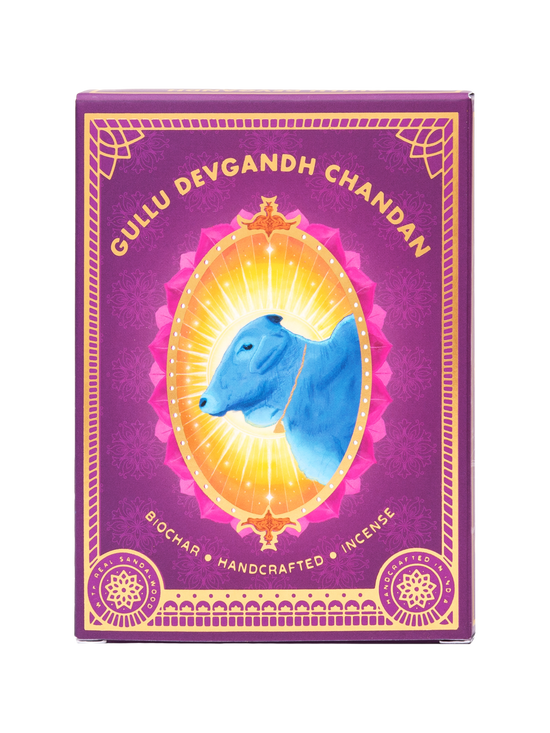
Gullu was a calf in the makers' family, remembered for a gentle nature, and Gullu Devgandh Chandan carries that name. "Chandan" is sandalwood, and "Devgandh" reads roughly as divine scent. The stick pays homage to aged sandalwood, the wood that once perfumed temples and royal courts. Once plentiful, its true depth has become elusive, which makes this a luxury incense in the old sense: precious for what it holds, not for how it is wrapped.
For anyone who remembers real sandalwood and misses it, this is the sandalwood incense to try. Warm woods and a thread of subtle spice come up slowly; the smoke is creamy, resinous and quietly luminous, and it lingers with a calm that seems to lower the volume of a room. It is the deepest stick in the range, the one to light when you want to think rather than celebrate.
Gold Twice Over: Swarna Champa and Kanak Bhawan
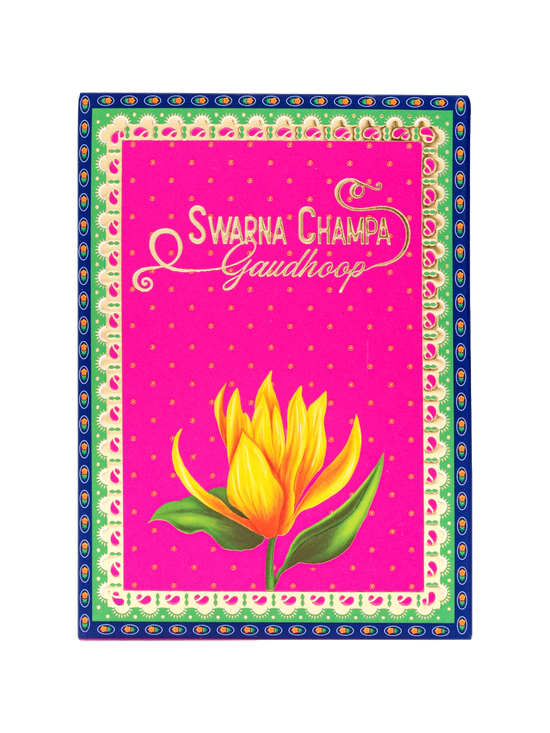
Gold runs through the other two sticks, though it means something different in each. "Swarna" is gold, and Swarna Champa honours the golden blossom of Magnolia champaca, long offered in temple rituals. Its smoke is sunny and tropical: jasmine-like sweetness, soft fruity undertones and a delicate powdery finish. Anyone raised on nag champa incense will recognise the family likeness, yet this is a champaca floral in its own right rather than another version of the familiar blend. The specialist blog Incense In The Wind, reviewing it under its earlier name, Magnolia Champaca, placed it at the top of its 2024 ranking of dhoops.
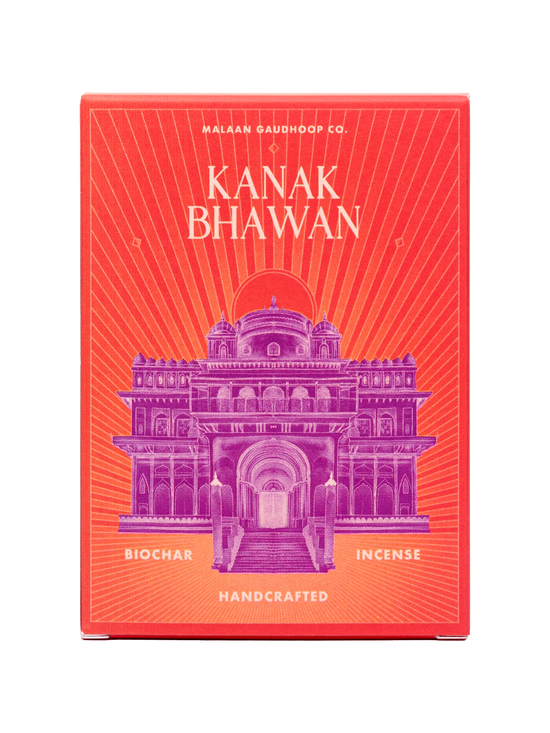
Kanak Bhawan, the "Palace of Gold", moves from temple to court. Inspired by the golden palaces of India's maharajas and maharanis, it is the richest in the range: lily of the valley, rose and geranium over patchouli, sandalwood, musk and spices. If Swarna Champa is morning sun across a courtyard, Kanak Bhawan is lamplight in a high-ceilinged room, warm, enveloping and a little regal. Between them, they take champa incense a long way from the market stall: Indian incense sticks with real composure.
Morning Light to Evening Guests: How to Choose and Burn Malaan Gaudhoop Incense
Let the hour decide. Swarna Champa belongs to mornings, a bright kitchen or a sunny sitting room. Gullu Devgandh Chandan suits meditation, yoga, a study or the reading chair. Kanak Bhawan is the evening stick, for a bedroom, a long dinner or the hour when guests arrive. Because each stick is so different, a box of each makes a generous first order or a thoughtful gift.
Each box holds 50 g, about fifteen hand-rolled sticks roughly 9 cm long and 8 mm thick, with a holder included. One stick burns for around 45 minutes and is enough for an ordinary room. Set it in its holder on a heat-proof surface in a ventilated room, away from curtains and draughts, keep it out of reach of children and pets, never leave it unattended and make sure it is fully out afterwards. Lit this way, it becomes an everyday ritual of the quietest kind, and every box helps keep the herd that gave the incense its name.